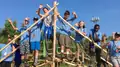
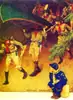
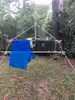
As the Story Goes: Members of the Enterprise’s fact-finding contingent consisting of Mr. Spock, Dr. McCoy, Lt. Sulu, and two members of security beamed down into what appeared to be a remote, forested area of a faraway planet in a newly charted solar system.
The camp staff placed a supply of materials in an open area by the lake assigned as the designated raft building place. Groups of Scouts could use any of the materials there to create whatever kind of raft they chose.
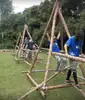
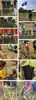
CLICK ON EACH PHOTO FOR A LARGER VIEW: Single Trestle Bridge Monkey Bridge Carousel Four-Sided Picnic Table Atomic Pile Team Building Station Square Lashing Instruction Climbing Platform Dish Washing Rack (Camp Gadget Display Area) Swing Derrick Trebuchet
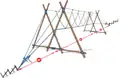
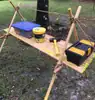
Click above for a larger view, to checkout the construction. This design was adapted from what John Sweet refers to as The Skylite in his booklet Pioneering in Town and Country . The main difference is the improvised framework for the two narrow quadpods is neither anchored or reliant on weighted supports, but instead is wide…
Here are some ideas to put outdoor skills into action at Scout meetings Outdoor skills aren’t just for the monthly campout. There are plenty of ways your Scouts can hone their outdoor skills on a regular basis, like during unit meetings.
Teach your Scouts how to build a monkey bridge Scouting founder Robert Baden-Powell believed every Scout should know how to build bridges. From designing the structure to gathering materials and putting it all together, bridge construction combines technology, teamwork and enthusiasm to complete a span that is memorable and useful.
Here are some ideas to put outdoor skills into action at Scout meetings Outdoor skills aren’t just for the monthly campout. There are plenty of ways your Scouts can hone their outdoor skills on a regular basis, like during unit meetings.
Here’s a simple way of setting up a dining fly in an open field A dining fly is one of the first structures you should put up at camp. But what if you’re in an area away from trees, how do you secure one?
Here’s a tip to help your Scouts remember how to tie a clove hitch Did you know a clove hitch is essentially two simple knots? When your Scout is tying lashings, all they need to know to create a clove hitch is how to tie a half-hitch.
As presented in Bryan on Scouting: Always tie a square knot correctly with this tip Tying a square knot might be confusing for Scouts. “Right-over-left” or was it “left-over-right?” For the next few weeks, we’ll be sharing some camp hacks that the BSA’s national camping subcommittee has shared with us.
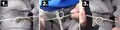
As presented in Bryan on Scouting: Try this easy technique next time you need to whip a rope Whipping a rope can be a little tricky. If your Scout is struggling with the traditional method , you can teach them another way, called “West Country whipping.”
Preventing the ends of rope from fraying is a process referred to as “whipping.” Learning how to whip the ends of a rope is one of the early requirements on the Scouts BSA advancement trail. Indeed there are many approaches to whipping a rope, but the one that’s used for the hundreds of lashing ropes…
With this smack-your-forehead, it’s-so-obvious, single-flag configuration, there’s no measuring the exact distance between where the clips will be applied to accommodate flags with varying spaces between their grommets. It’s a simplistic approach that works well in light conditions for shorter periods of time.
Of course you’ve gotta love this (and all) Norman Rockwell paintings, but this one is always timely, and perhaps now more than ever. The kind of Scouting adventure that younger Scouts can look forward to needs to be evidenced by the troops they observe.
The Diamond Hitch was many times more prevalent a couple of decades past, and was featured throughout a range of Scout publications. It’s not actually associated with Scout Pioneering, but it’s still an example of nifty rope work. Though there’s not nearly as many packboards in use today, the Diamond Hitch still can serve as…
Pioneering projects can be built to serve a practical purpose, as in a bridge connecting two banks of a stream providing a shortcut to the dining hall, or simply for recreation as in a swing boat at a Scout Expo.
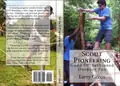
Scout Pioneering, Good Ol’ Fashioned Outdoor Fun, is filled with all the information, illustrations, and instructions a unit needs to get an effective pioneering program off the ground and flourishing. Along with the author’s first-hand experience as a Scout leader who has run successful pioneering programs in his own troop and at the Philmont Training…
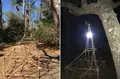
A crew of Scouts went about erecting a FLOATING FLAGPOLE made entirely of Scout staves. They lashed together five staves for the pole and two staves each for the three supporting uprights. The idea was to rely upon the strain of the guylines to keep the uprights straight, without sinking them into the ground.
Use the support ropes as guylines! Pound in the stakes about 4 feet out from the center pole. A Better Clothes Drying Rack Just like holding a flagpole erect, there’s no need to attach the center pole to a pioneering stake or sink it into the ground.
These camp gadgets were featured in the Pioneering Village at the 2017 National Jamboree. All were fashioned out of Scout staves and precut lengths from broomsticks. Left Column, from the Top: Dish Washing Station, Camp Table, Simple Camp Table, Hand Wash Station, Single Fire Bucket Holder, Tripod Straddle Seat / Right Column from the Top: 15′…
This small camp table can be comprised almost completely of Scout staves. It’s 100% functional and provides a convenient raised surface for personal, patrol, or general use. It’s simple design makes it quick and easy to set up, and it is remarkably stable.
Troop 86 from Sumter, SC wanted to do a pioneering project and they selected the Double A-Frame Monkey Bridge. Great place to start, and a great way to illustrate sequential programming . What skills enter into the picture? A whole bunch!
Pioneering Information Troop Meetings Main Event John Thurman, Gilwell Camp Chief for twenty-five years, said, ”There is only one activity in my experience where it pays to start at the top, and that is swimming. It is true that pioneering has often been directly or unexpectedly linked with swimming, but if any patrol, troop, or…
“Pioneering is practical and character building: the two essential ingredients of any program material for Scouts.” (Lord Baden-Powell) Pioneering Merit Badge, which as we all know used to be required for Eagle, should give Scouts a taste of pioneering! Of course they should be taught about safety and gain some general knowledge, but much more…
Though the clove hitch is most always taught by laying two turns around the pole to form an ‘X’ and then passing the running end underneath, the approach presented in this video is an essential one that should come into play anytime a lashing is finished with a clove hitch.
Double A-Frame Monkey Bridge Constructed using “Sandwiched” 2x4s Yes. That’s how Venture Crew 140 out of Houston, Texas put some newly-learned lashing skills into action. They also experienced, first hand how rope tackles can put the necessary strain on thick lines used for hand and foot ropes.
These are some ideas for a Main Event from the revised Pioneering Module of Program Features for Troops, Teams and Crews. Click above for an enlarged view. The following three sample outing outlines can serve troop leaders as a point of reference, or as an actual framework, for the monthly main event relating to the…
This post is a component of the revised pioneering module in Program Features for Troops, Teams and Crews. Related Advancement First Class Tools requirements Pioneering Merit Badge What is Pioneering? – Pioneering is the knowledge and skill of using simple materials to build structures that are used in a wide range of Scouting activities.
In all Scouting activities, safety must come first. In and through the challenges, fun, and rewards that go hand in hand with Pioneering, there can be no substitute for prudent behavior and common sense. As you begin your pioneering activities, safety must be your first consideration.
Put most simply, the sheet bend is a very useful knot. It’s a very basic joining knot for tying two ropes together, and when a lot of pull is applied, it’s easier to undo than a square knot (Reef Knot).
A flagpole suspended off the ground by a series of lines, so that it appears to be floating, can be a really neat project. The structural principle has been referred to as tensegrity , and is based on using one half the lines to lift the pole off the ground, and the other half to give…
Any pioneering project that cannot safely stand by itself needs to be attached to something that will securely hold it in place. It has to be anchored. Sometimes nature will provide a tree or rock in just the right location or you might be able to shift the project’s placement to take advantage of a…
The following text is by Adolph E. Peschke as presented in the 1998 printing of the 1993 edition of the Pioneering Merit Badge Pamphlet: You might never be called upon to throw a line to someone in distress; however, it’s the Scouting way to be prepared .
Often times at a campsite, there are no picnic tables with benches, or array of thick, wooden discs from downed trees positioned around a fire site, or fallen tree trunks, or a large outcrop of smooth boulders. So, through the years, the answer to the query, “what will I sit on during a camping trip?”
When tying the basic, oft-used, simple “two-half-hitches” (double-half-hitch), instead of applying a clove hitch around the standing part, there’s a thing about mistakingly tying a lark’s head. This accident rears its head time and again, and many Scouts (both youth and adult) somehow don’t recognize the difference.
VIEW VIDEO: How to Tie a Zeppelin Bend The Zeppelin bend is such a secure joining knot, it’s reputed to have been used by the US Navy used it to moor airships (zeppelins). It’s easy to tie, will not fail, and most significantly, it’s easy to untie.
Down through the decades, Scout Pioneering has always consisted of building bridges, towers, and… RAFTS . Raft building provides some unique challenges, and is fun in many ways. Whenever you don’t have a boat or canoe, and there’s a desire to float on, or across, a body of water, making a raft is what commonly comes…
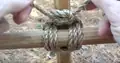
After being excluded in all previous editions, the 13th Edition of The Boy Scout Handbook features the Japanese Mark II Square Lashing —a very good thing! Referred to simply as “The Mark II Square Lashing,” it’s included along with the other lashings in Chapter 12.
The following piece was composed for a BSA ScoutCast. The concept applies admirably to pioneering when Scouts, who who have the proper “tools” and are capable and ready, care to embrace the construction of any-size pioneering project. The Guided Discovery Process is a fancy term for what?
The “Tong Method” When it’s time to use a hand ax to split larger pieces of wood into kindling, currently the only method in BSA literature is the contact method where one hand holds the ax’s handle, and at all times the other hand grasps the piece of wood being chopped.
Plastic Sheet Shelters In the light that Pioneering has been referred to as “Scout Engineering,” many projects can be considered a pioneering-related venture when Scouts are confronted with fashioning and building something requiring intelligent use of their resources, consideration of angles, trajectory, and some campcraft skills.
14′ Double Ladder Signal Tower Before the advent of BSA height restrictions on pioneering projects, the boy-sized, 14′ Double Ladder Signal Tower was built by Scout units, Scout pioneering crews, and Pioneering Merit Badge classes on a regular basis. Because it’s such a fine example of Scout Engineering, it has continued to be a feature…
Assembling their Ballista First of all, let’s acknowledge what appears to be the source for this easy-to-execute design, the website for: Scouts South Africa where you can download a pdf of the design and directions. The activity surrounding the construction of this launcher incorporates sound Square Lashing technique, teamwork (of course), a geometric study of…
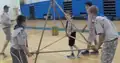
12′ Scout Swing Seeing Action at a Public Scout Expo This is a simple project that is bound to get lots of play. Therefore, lashings need to be super tight, and eight sturdy pioneering stakes will serve as anchors and need to be driven solidly into the ground, perpendicular to and touching the six spars…
Addressing the basic and ongoing quandaries, HERE’S A VIDEO: You Tube Version (if Vimeo is malfunctioning) Some Questions and Some Answers about Rope for Lashing: What kind of rope should we use? For most projects, 1/4 manila. Refer to: Rope for Pionering and Camp Use What length(s) should we cut the rope into?
Addressing the basic and ongoing quandaries, HERE’S A VIDEO: You Tube Version (if Vimeo is malfunctioning) Some Questions and Some Answers about Rope for Lashing: What kind of rope should we use? For most projects, 1/4 manila. Refer to: Rope for Pionering and Camp Use What length(s) should we cut the rope into?