Pioneering Information Troop Meetings Main Event John Thurman, Gilwell Camp Chief for twenty-five years, said, ”There is only one activity in my experience where it pays to start at the top, and that is swimming. It is true that pioneering has often been directly or unexpectedly linked with swimming, but if any patrol, troop, or…
“Pioneering is practical and character building: the two essential ingredients of any program material for Scouts.” (Lord Baden-Powell) Pioneering Merit Badge, which as we all know used to be required for Eagle, should give Scouts a taste of pioneering! Of course they should be taught about safety and gain some general knowledge, but much more…
Though the clove hitch is most always taught by laying two turns around the pole to form an ‘X’ and then passing the running end underneath, the approach presented in this video is an essential one that should come into play anytime a lashing is finished with a clove hitch.
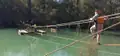
Greg from West Australian Scout Pioneering wrote in with photos and a description of the awesome bridge, supported by A frames on each end and a raft in the centre. Here's Gregs description: Photo courtesy Greg Barbera Project : Build a Rope bridge for the West Australian Cub Scout event – Enduro Location: Manjedal Activities Centre (M.A.C)…
Double A-Frame Monkey Bridge Constructed using “Sandwiched” 2x4s Yes. That’s how Venture Crew 140 out of Houston, Texas put some newly-learned lashing skills into action. They also experienced, first hand how rope tackles can put the necessary strain on thick lines used for hand and foot ropes.
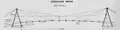
I found this suspension bridge article written by L.C. Sands in the February 1937 Scouter magazine: No special credit is claimed for having succeeded in building the bridge described here, as it involves a principle in common use, but as the writer has not seen anything similar described in any of the books on pioneering…
These are some ideas for a Main Event from the revised Pioneering Module of Program Features for Troops, Teams and Crews. Click above for an enlarged view. The following three sample outing outlines can serve troop leaders as a point of reference, or as an actual framework, for the monthly main event relating to the…
This post is a component of the revised pioneering module in Program Features for Troops, Teams and Crews. Related Advancement First Class Tools requirements Pioneering Merit Badge What is Pioneering? – Pioneering is the knowledge and skill of using simple materials to build structures that are used in a wide range of Scouting activities.
In all Scouting activities, safety must come first. In and through the challenges, fun, and rewards that go hand in hand with Pioneering, there can be no substitute for prudent behavior and common sense. As you begin your pioneering activities, safety must be your first consideration.
Put most simply, the sheet bend is a very useful knot. It’s a very basic joining knot for tying two ropes together, and when a lot of pull is applied, it’s easier to undo than a square knot (Reef Knot).
A flagpole suspended off the ground by a series of lines, so that it appears to be floating, can be a really neat project. The structural principle has been referred to as tensegrity , and is based on using one half the lines to lift the pole off the ground, and the other half to give…
Any pioneering project that cannot safely stand by itself needs to be attached to something that will securely hold it in place. It has to be anchored. Sometimes nature will provide a tree or rock in just the right location or you might be able to shift the project’s placement to take advantage of a…
This slideshow requires JavaScript. Click here to watch a video tutorial. The timber hitch is the perfect knot to use for dragging a log across the ground. It is also the knot that starts a diagonal lashing. Here's how to tie a timber hitch: Pass the running end of the rope around a log.
This slideshow requires JavaScript. Click here to watch a video tutorial. The clove hitch is used to begin and end many lashings. Here's how to tie it: Bring the running end of the rope over and under a pole. Take the end around a second time, crossing over the first wrap to form the shape…
This slideshow requires JavaScript. Click here to watch a video tutorial. The sheet bend is the preferred knot for tying together two ropes of the same or different diameters. Here's how to tie the sheet bend: Make a bight in the end of the thicker rope and hold it with one hand.
Often times at a campsite, there are no picnic tables with benches, or array of thick, wooden discs from downed trees positioned around a fire site, or fallen tree trunks, or a large outcrop of smooth boulders. So, through the years, the answer to the query, “what will I sit on during a camping trip?”
When tying the basic, oft-used, simple “two-half-hitches” (double-half-hitch), instead of applying a clove hitch around the standing part, there’s a thing about mistakingly tying a lark’s head. This accident rears its head time and again, and many Scouts (both youth and adult) somehow don’t recognize the difference.
Catdrill 'lashing' details 'CatDrill' is an Italian technique for staving or lightweight pioneering , that involves preparing the staves to be used by drilling a small hole and notching the surface of the pole. Lightweight synthetic kernmantle rope is then used to tie the staves together, using stopper knots on the starting end of the rope…
Down through the decades, Scout Pioneering has always consisted of building bridges, towers, and… RAFTS . Raft building provides some unique challenges, and is fun in many ways. Whenever you don’t have a boat or canoe, and there’s a desire to float on, or across, a body of water, making a raft is what commonly comes…
After being excluded in all previous editions, the 13th Edition of The Boy Scout Handbook features the Japanese Mark II Square Lashing —a very good thing! Referred to simply as “The Mark II Square Lashing,” it’s included along with the other lashings in Chapter 12.