John Thurman Some special quotes by JOHN THURMAN , Camp Chief, Gilwell Park from 1943-1969: “ There are few activities which, properly presented, have a greater appeal to the Scout and Senior Scout than Pioneering and ever since the introduction of Wood Badge training, Pioneering has been given a full share in the programme of Scouters’ training.
Adjusting knots and lashings after the first test crossing. The well-known, time-tested, traditional Monkey Bridge is perhaps the most familiar of all Scout pioneering projects. It’s frequently featured at Scout Expos, Camporees, Scout Camps, and is often a central attraction at public gatherings where Scouting is represented.
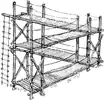
The Three Phases of the Chippewa Kitchen Cooking Experience The Chippewa Kitchen can be seen as the indisputable KING of all “camp gadgets.” It’s the ultimate camp kitchen pioneering project, providing a huge element of convenience to a wide range of camp cooking operations.
How fast can the flag be raised! Flags engender pride! Flying ‘em high is great for Scout spirit, and making a flagpole is really easy. All you need are straight sticks (Scout staves work great), rope for round lashings, rope for guy lines, and three stakes.
UNDERWATER See-Saw We were introduced to and adapted this project thanks to the great Pioneering Made Easy website. It was inspired by Fun With Ropes and Spars by John Thurman who, with his inimitable approach to providing pioneering challenges and robust Scouting activities, dubbed it the “Underwater See-Saw.”
Functional AND good-looking. One of the essential mandates in the B.S.A.’s Outdoor Code is: BE CAREFUL WITH FIRE. I will prevent wildfire. I will build my fires only where they are appropriate. When I have finished using a fire, I will make sure it is cold out.
Pioneering has always been part of Baden-Powell's vision of Scout training, from the first edition of Scouting for Boys (Chapter IV- Camp life- deals with huts, bridges, towers and lashings). BP would have been exposed to pioneering as a military discipline in the army- pioneers were engineers who moved in front of the main column…
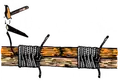
One of the very first times, if not the first time that the Japanese Square lashing appeared in print was in John Thurman’s Pioneering Principles in 1962. John Thurman was an influential British Scouter who discovered the lashing while on a tour of Japan, hence the name.
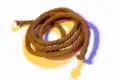
Knoopenzo.nl (Knots etc.) is a Dutch website run by Theo Slijkerman, a member of the International Guild of Knot Tyers . The website has a number of very interesting knotting resources, including calculators for working out the amount of rope needed for a rope mat , a turks head and a braided ring .
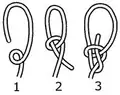
The Taut-line Hitch is a requirement for the Boy Scout Rank of ‘Tenderfoot’, and is a very useful knot to know. It is used to add tension to a line. It is often employed to tie down loads on vehicles or set up tents.
Two half hitches is a simple and secure knot that is used to fix the end of a rope to an object. It is one of the required knots for the Tenderfoot Rank in Boy Scouts. Enjoy this tutorial! If you have any questions, feel free to leave a comment!
Reef knot, also known as square knot (Photo credit: Wikipedia) The square knot is the first knot a boy must know to become a Boy Scout . It is an amazingly versatile and useful knot, yet many people don’t know how to tie it.
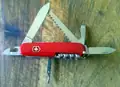
A good multitool comes in very handy in many Scouting (and every day) situations. The difficulty lies in balancing between having a large tool that prepares you for every possible eventuality, and a lighter tool that includes most practical tools.
The rabbit comes out of the hole.. goes around the tree.. and back into the hole.. now pull… It's a bowline. Its that simple. That simple to teach, that simple to do. And it's a knot that every Scout must know.
1st Bothasig Rover Crew in the Western Cape, South Africa, have been trying out some new pioneering projects. Here is a scaled-up version of a Skylon flagpole that aims to be large enough to have a crows-nest / deck on top.
This newspaper clipping from the 4th of May 1973 shows single lock trestle bridges built by Scout troops in Benoni, at a competition camp at Arrowe Park . From the accompanying article: Benoni District Scouts attended a camp competition last weekend at Arrowe Park, organised by fourth Benoni Rover Crew.
Each month, this blog features one of the program elements that will be offered at the 2013 Jamboree. Last month, we talked about the "jamboree trek" to Garden Ground Mountain, as well as some information on Order of the Arrow Indian Village.
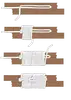
Round lashings seem to be tied with many different methods. According to the Dutch Scout wiki , this is how the Dutch speaking Scouts do it - with turns that run around the poles in both directions and are bound with a reef knot.
Main gateway at the 22nd World Scout Jamboree, Rinkaby, Sweden As mentioned in the last post , I recently returned from the 22nd World Scout Jamboree in Rinkaby, Sweden. I was travelling as the Troop Scouter of Drakensberg troop , in the South African contingent .
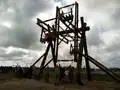
When you get to the top, hang onto your rope!" Those aren't the words you'll typically hear on a Ferris wheel. Then again, this isn't your typical Ferris wheel. This is the World Scout Jamboree version, a feat of pioneering that puts any monkey bridge I ever built to shame.
Before you leave your entry this week be sure to use the link below to send in your photo for a future contest ! Can you identify this pioneering project with an appropriate caption? Post your best idea below (one per person please!)
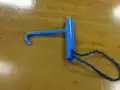
These hooks are designed for untying stubborn lashings. I haven't used one myself yet, but they look pretty handy. Made by Ken Stanton, those of you in South Africa can pick one up for R25 from Bramley Scout Shop
The traditional lashing for extending poles is the round lashing . Recently I blogged about an alternative, the German round lashing . My troop did some tests to see which of the two works better. After teaching both knots to their patrols, the Patrol Leaders made two sets of round lashings, one with the shear lashing and…
This lashing, a simple whipping applied to two poles, is an alternative to the Round lashing . I found this on the German Scout Wiki (here in English for those who don't read German). My troop will be doing some experiments to see whether this knot performs as well (or better) than the round lashing The…
Mike Malone asks; ... we've been informed that, for safety reasons, Scouts are now not allowed to be on any handmade structure more than 3-4 feet off the ground. Is that the current rule? I checked the Guide to Safe Scouting and found two statements that may be applicable: An approved climbing helmet must be worn…
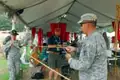
Soldiers out of Fort Leonard Wood, Mo., with the Joint Task Force-National Scout Jamboree man the pioneering merit badge booth and assist boy scouts with the tasks necessary to earn the badge at the Boy Scouts of America 2010 National Boy Scout Jamboree held at Fort A.P.
When I was a Boy Scout in the mid 1970's we needed to earn belt loops called skill awards for the first three ranks. Each skill award was based on a certain set of skills, such as camping, hiking, or swimming.
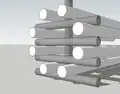
I posted this photograph of Adiero 's octopod cloverleaf lashing at Kontiki. Here is the formwork needed to support it while tying the lashing (thanks to Louise from Adiero for the explanation): The vertical pole is a stake that supports the stack of poles to be lashed.
1 Vote On Idea The big picture is about "Engaging Young Minds" (Scouts) by starting National (local) Boy Scout Engineering & Pioneering Competitions, much like Don Murphy did for the Cub Scouts by inventing the Derby Car Races. www.PioneeringCompetitions.com is a site with puzzle boards that create a foundation to help with five different Boy Scout…
Picked up the 12th edition this week. Here's some observations having skimmed through it. Negatives : The book is 1/2 inch shorter than the previous. This just means I've got a floppy black book cover on it now. The back cover used to have three words - Character, Citizenship, Fitness - and I'd often use that when talking…
I did my Woodbadge course in the fall of 1988. Yes, that was long before the current "Woodbadge for the 21st Century", but I have a feeling the core training is still pretty much the same. The course was held at Camp Stearns in central Minnesota.
I've featured a few JOTA towers , but no JOTI pioneering.. until now. :) We were relying on a wireless internet connection this weekend, so the modem needed to be placed high up for good signal. So here is the modem, securely lashed to the wan router , both suspended from a window in our Scout hall.
These projects are all built by troops in the Northern District in Gauteng, South Africa. This district holds regular inter-troop Pioneering competitions, as well as a Scouter's competition. The above photo shows the winning Scouters from 2008, 1st Athol, in front of their 35ft-span suspension bridge, built in 4.5 hours.
Author Gerald Finley has put together a fine, no-nonsense book 'Rope Works Plus'. The expanded version of his original 1997 book 'Rope Works' features clearly illustrated directions for tying and using knots, splices and lashings, making rope (with plans for a geared rope making machine) and netting.
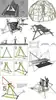
Japanese traditional architecture and crafts are a great source for inspiration about lashings and pioneered structures. The images above and below are from the book 'Structure and Form in Japan' (apparently out of print but possibly available from Amazon.com ) Flickr user Anthony Grimley took this beautiful photograph of a fence outside a tea house: And…
I received an e-mail this week asking for advice on the best simple project for people who have never done any pioneering before. I suggested an A-frame, because it is a simple, stable structure that is quick to build and can be used for many fun activities.
Browsing the 3D Warehouse the other day, I found an incredible model TaffGoch posted - a bowline made entirely in SketchUp. This is a pretty impressive piece of modelling work, and complete instructions for modelling a knot are included. The first file shows how to model the shape of the knot, while the second one shows…
Keat Lee is a former Scout from Malaysia who has shared some model pioneering photos with me. The five models featured in this post are all of Keat's own design- thanks for sharing them with us! Keat uses cotton thread to tie the lashings, and uses real square and diagonal lashings, not the elastic band…
Scouting is a worldwide movement - it is thought that there are only six countries on Earth that have no Scout troops. I've been lucky enough to speak to Scouts all over the world while I've been running this blog. I realised the other day that I've spoken to Scouts on every continent on earth, except…
HalfEagle uses Google Analytics cookies to count visits to each page. Is that OK?